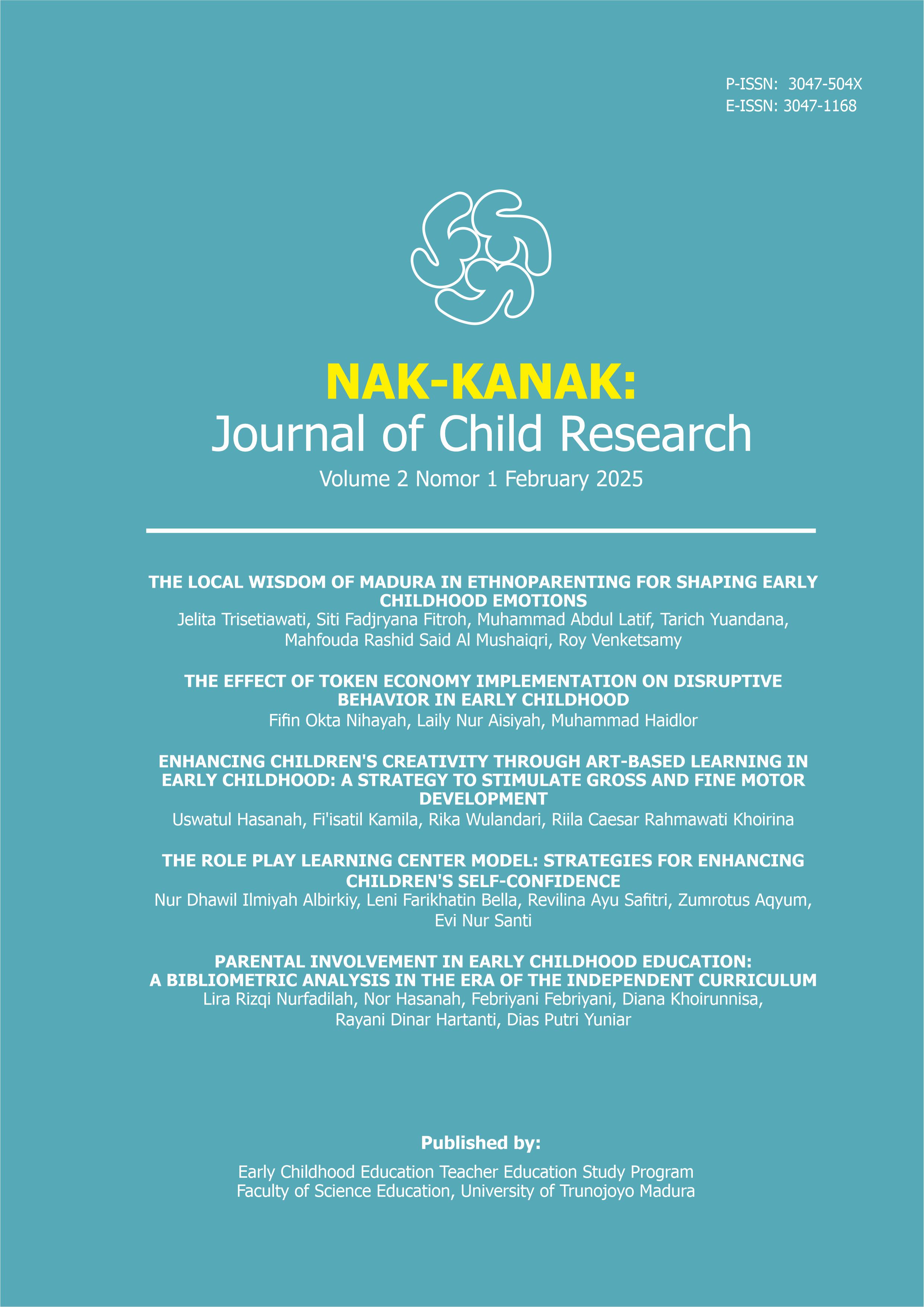
The Role Play Learning Center Model: Strategies for Enhancing Children's Self-Confidence
DOI:
https://doi.org/10.21107/njcr.v2i1.135Keywords:
Learning Center Model, Role Play, Self-ConfideceAbstract
Background of the study: The Role-Play Center Learning Model is a child-centered educational approach conducted through Circle Time and thematic learning centers. In the role-play center, children are encouraged to explore their abilities according to their interests and talents, stimulating various aspects of multiple intelligences through guided play. This approach is designed to foster not only cognitive growth but also emotional and social development in early learners.
Aims and scope of paper: This study aims to investigate whether the implementation of the role-play center learning model at TK Darunnajah Kamal effectively supports the development of multiple intelligences and enhances children’s self-confidence.
Methods: The study employed a qualitative field research design. Participants included the principal, the role-play center teacher, and students. Data collection techniques involved observation (focused on children's activities and the learning environment), in-depth interviews, and documentation. Data analysis was conducted using the Miles and Huberman interactive model, which includes data display and conclusion drawing.
Results: The findings indicate that the role-play center at TK Darunnajah Kamal allows children the freedom to choose their own activities under the guidance of teachers. Most of the children demonstrated increased self-confidence during learning activities. They were able to express their desires without fear of making mistakes, showing progress in both autonomy and communication skills.
Contribution: This study contributes to the field of early childhood education by providing evidence of the effectiveness of center-based learning in supporting multiple intelligences and self-confidence. It also offers practical implications for educators seeking to design more inclusive and empowering learning environments in early childhood settings.
References
Al-hasna, B. D. T. K. I. T., & Hasanah, N. (2020). Implementasi Model Sentra Bermain Peran Pada Anak Kelompok B Di TK IT Al-Hasna. Jurnal Golden Age, 4(01), 167–181. https://doi.org/10.29408/jga.v4i01.2224
Alif, A., & Wulantika, W. (2020). Penerapan Pembelajaran Berbasis Sentra Bermain Peran Terhadap Perkembangan Sosial Emosional Pada Anak Usia Prasekolah. Jurnal Seminar Nasional Pendidikan. Hlm, 29–38. Retrieved from http://ap.fip.um.ac.id/wp-content/uploads/2017/12/Adlan-Alif-Widya-Wulantika.pdf
Bakri, A. R., Nasucha, J. A., & Indri M, D. B. (2021). Pengaruh Bermain Peran Terhadap Interaksi Sosial Anak Usia Dini. Tafkir: Interdisciplinary Journal of Islamic Education, 2(1), 58–79. https://doi.org/10.31538/tijie.v2i1.12
Bogdan, R., & Biklen, S. K. (2007). Qualitative Research for Education: An Introduction to Theories and Methods (5th ed.). In Alien and Bacon, Inc, New York.: Pearson A & B. Retrieved from https://books.google.co.id/books/about/Qualitative_Research_for_Education.html?hl=id&id=HSMiAQAAIAAJ&redir_esc=y
Emzir. (2013). Metodologi Penelitian Pendidikan Kuantitatif dan Kualitatif. Rajawali Press.
Khairiah, D., & Kurinci, D. I. (2022). Model Pembelajaran Sentra Pendidikan Anak Usia Dini Di Kb Al – Falah Kota Gunungsitoli. BUHUTS AL-ATHFAL: Jurnal Pendidikan Dan Anak Usia Dini, 2(1), 36–48. https://doi.org/10.24952/alathfal.v2i1.5289
Syahria, A. I. (2021). Penerapan model pembelajaran sentra dalam mengoptimalisasikan perkembangan motorik halus anak usia 5-6 tahun di kb paud bee audi.
Downloads
Published
How to Cite
Issue
Section
License
Copyright (c) 2025 Nur Dhawil Ilmiyah Albirkiy, Leni Farikhatin Bella, Revilina Ayu Safitri, Zumrotus Aqyum, Evi Nur Santi

This work is licensed under a Creative Commons Attribution-NonCommercial 4.0 International License.
The authors publishing in this journal agree to the following terms:
1. Authors retain copyright and grant the journal the right of first publication with the work simultaneously licensed under a Creative Commons Attribution License that allows others to share the work with an acknowledgement of the work's authorship and initial publication in this journal.
2. Authors are able to enter into separate, additional contractual arrangements for the non-exclusive distribution of the journal's published version of the work (e.g., post it to an institutional repository or publish it in a book), with an acknowledgement of its initial publication in this journal.
3. Authors are permitted and encouraged to post their work online (e.g., in institutional repositories or on their website) prior to and during the submission process, as it can lead to productive exchanges, as well as earlier and greater citation of published work.