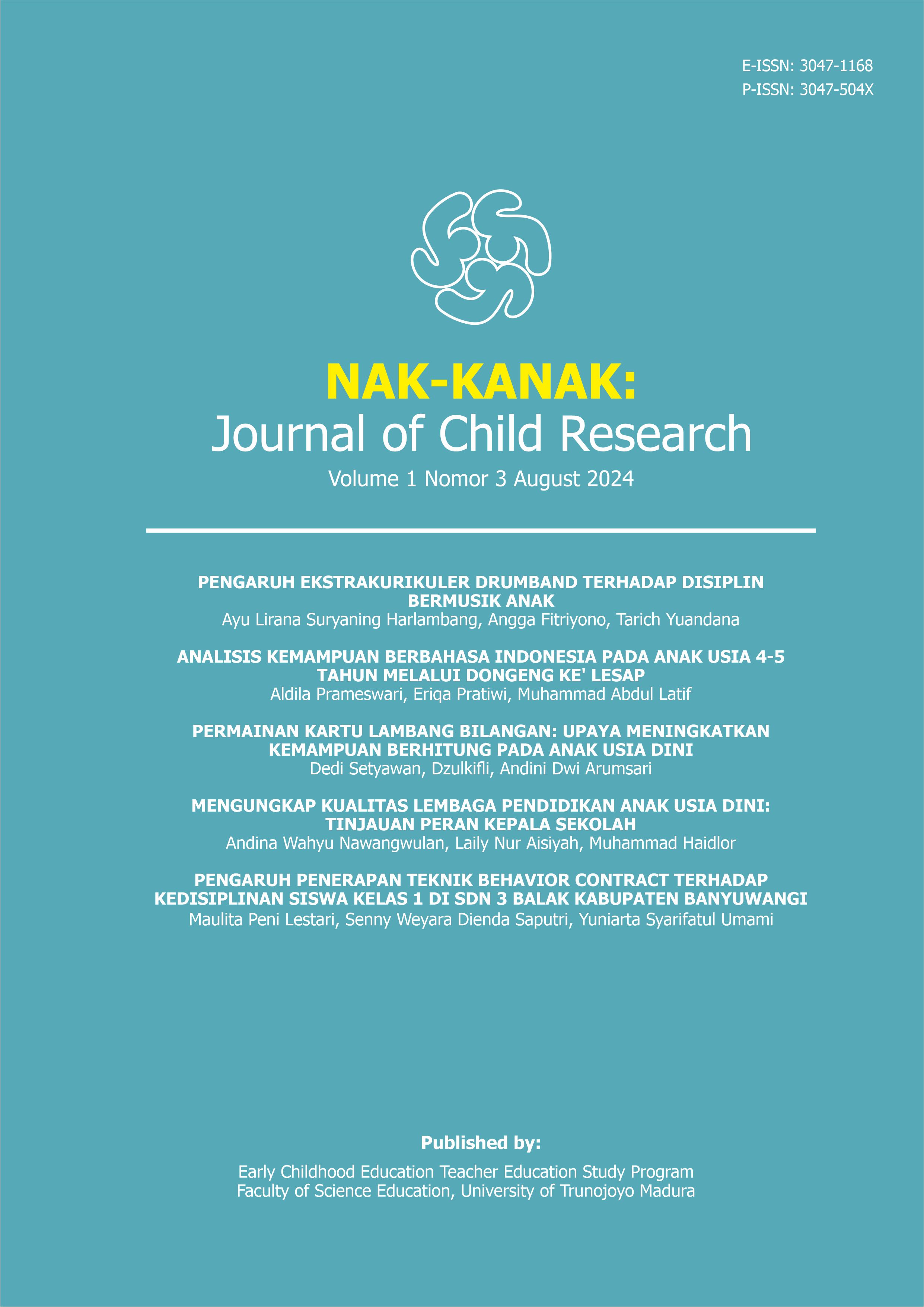
Analisis Kemampuan Berbahasa Indonesia Pada Anak Usia 4-5 Tahun Melalui Dongeng Ke’ Lesap
DOI:
https://doi.org/10.21107/njcr.v1i3.68Keywords:
Kemampuan Bahasa Indonesia, Anak Usia Dini, Dongeng Ke’lesapAbstract
This study aims to analyze the Indonesian language skills of children aged 4-5 years through the story of Ke' Lesap. The research method used is descriptive qualitative. The subjects of this study are children in the 4-5 age group, focusing on their ability to understand and use Indonesian after being exposed to the story. Data collection was conducted through direct observation and interviews with teachers and parents to obtain a comprehensive picture of the children's language development. The results of this study show that children in this age range are already able to use Indonesian well. They demonstrated improvements in vocabulary, sentence structure, and narrative ability after routinely listening to the story of Ke' Lesap. A significant factor contributing to this improvement is the stimulus provided by the storytelling. The story of Ke' Lesap not only captures children's attention but also stimulates their imagination, which in turn encourages them to communicate more actively and use Indonesian in their daily lives. Furthermore, this study found that storytelling is very effective in introducing complex language concepts in a fun and easily understood manner by children. Teachers and parents also reported increased motivation among children to learn and communicate after participating in storytelling activities. Thus, it can be concluded that the story of Ke' Lesap is highly effective in developing the Indonesian language skills of children aged 4-5 years. This study suggests that storytelling methods should be used more frequently in early childhood education programs to enhance language skills and communication abilities. These findings also contribute significantly to the development of more creative and story-based educational curricula for children.
Downloads
Published
How to Cite
Issue
Section
License
Copyright (c) 2024 Aldila Prameswari, Eriqa Pratiwi, Muhammad Abdul Latif

This work is licensed under a Creative Commons Attribution-NonCommercial 4.0 International License.
The authors publishing in this journal agree to the following terms:
1. Authors retain copyright and grant the journal the right of first publication with the work simultaneously licensed under a Creative Commons Attribution License that allows others to share the work with an acknowledgement of the work's authorship and initial publication in this journal.
2. Authors are able to enter into separate, additional contractual arrangements for the non-exclusive distribution of the journal's published version of the work (e.g., post it to an institutional repository or publish it in a book), with an acknowledgement of its initial publication in this journal.
3. Authors are permitted and encouraged to post their work online (e.g., in institutional repositories or on their website) prior to and during the submission process, as it can lead to productive exchanges, as well as earlier and greater citation of published work.