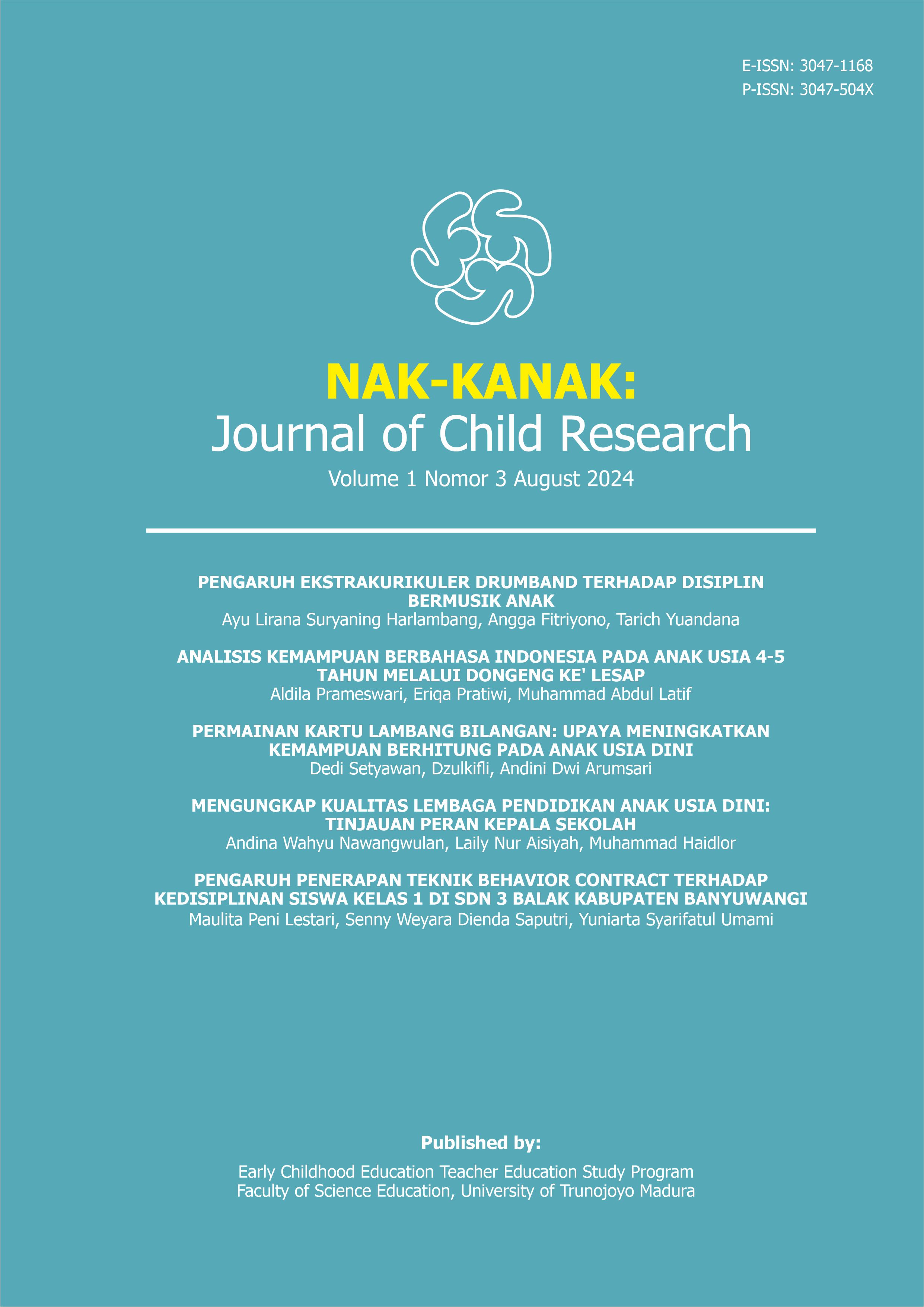
Mengungkap Kualitas Lembaga Pendidikan Anak Usia Dini: Tinjauan Peran Kepala Sekolah
DOI:
https://doi.org/10.21107/njcr.v1i3.73Keywords:
The Role of the Principal, Quality of Education, Early Childhood Education InstitutionsAbstract
The quality of education can be measured by the role of the principal. This study aims to describe the role of the principal in the quality of education at TK Arni Jember. The method used is a descriptive method in the form of spoken and written words from the subject of the perpetrators observed using a qualitative approach. Data collection techniques used are observation, interview and documentation techniques. The subjects of this study consisted of the principal and teachers at TK Arni Jember. Data analysis of the study used a model developed by Milles and Huberman. The results of this study explain that the quality of education at TK Arni Jember has met the National Education Standards and the role of the principal in improving the quality of education in the institution has been running well. This can be seen in terms of the quality of education and work programs that have been implemented well from time to time. The principal as a leader always outlines the school's vision and mission to achieve quality targets, involves teachers and parents in school decision-making, always provides innovation, motivation and work enthusiasm to all educators and education staff so that they remain enthusiastic in carrying out their duties to continue to improve the quality of education at TK Arni Jember.
Downloads
Published
How to Cite
Issue
Section
License
Copyright (c) 2024 Andina Wahyu Nawangwulan, Laily Nur Aisiyah, Muhammad Haidlor

This work is licensed under a Creative Commons Attribution-NonCommercial 4.0 International License.
The authors publishing in this journal agree to the following terms:
1. Authors retain copyright and grant the journal the right of first publication with the work simultaneously licensed under a Creative Commons Attribution License that allows others to share the work with an acknowledgement of the work's authorship and initial publication in this journal.
2. Authors are able to enter into separate, additional contractual arrangements for the non-exclusive distribution of the journal's published version of the work (e.g., post it to an institutional repository or publish it in a book), with an acknowledgement of its initial publication in this journal.
3. Authors are permitted and encouraged to post their work online (e.g., in institutional repositories or on their website) prior to and during the submission process, as it can lead to productive exchanges, as well as earlier and greater citation of published work.