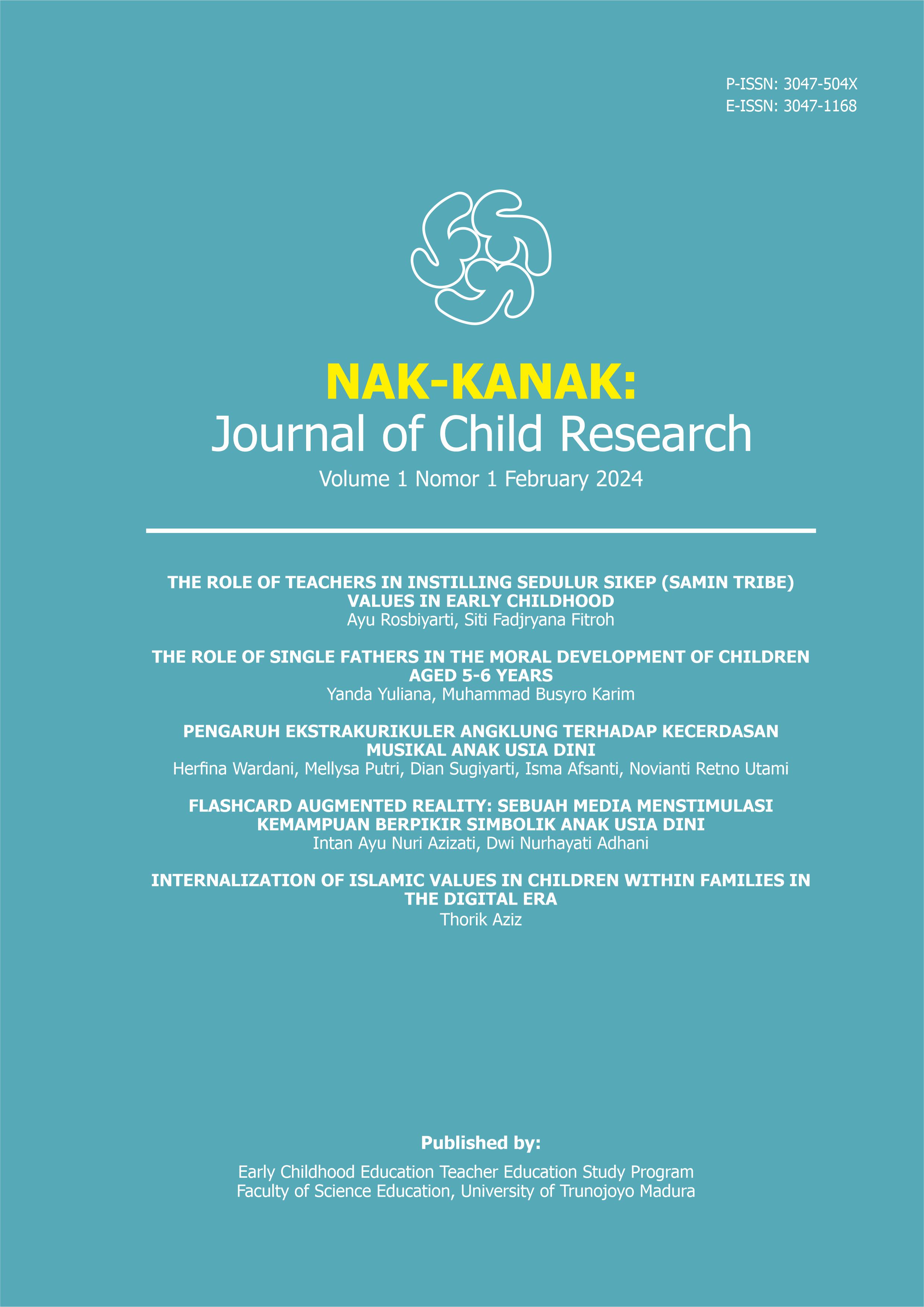
Flashcard Augmented Reality: Sebuah Media Menstimulasi Kemampuan Berpikir Simbolik Anak Usia Dini
DOI:
https://doi.org/10.21107/njcr.v1i1.48Keywords:
Augmented Reality, Symbolic Thinking Ability, Early Childhood EducationAbstract
This study was conducted to investigate the effectiveness of using augmented reality flashcards in stimulating the cognitive development of 4-5-year-old children at TK Bina Ria, particularly in symbolic thinking abilities. The research employed a quantitative experimental model with a Pre-Experimental design, specifically the One Group Pretest design. The study population comprised children aged 4-5 years attending TK Bina Ria, with a sample size of 30 children selected using nonprobability sampling techniques. Data collection methods included tests, observations, and documentation. The research findings indicated that the use of augmented reality flashcards stimulates cognitive development in symbolic thinking abilities. Flashcards with relevant symbols, words, numbers, and pictures assist children in visually grouping, collecting, and organizing objects. This aids them in recognizing logical relationships, categorizing objects, and concretizing ideas. The study also noted that the preoperational stage, which involves various cognitive abilities relevant to children's symbolic thinking, aligns with Piaget's theory. Upon reviewing the results of the t-test, a Sig value (2-tailed) of 0.000 < 0.05 was obtained, indicating a significant difference between pretest and posttest values. This significant difference is evident in the average scores before and after the implementation of the media, with a pretest average of 12.33 and a posttest average of 28.67. This study contributes to providing one method of stimulating children's symbolic thinking abilities through the use of augmented reality flashcards
Downloads
Published
How to Cite
Issue
Section
License
Copyright (c) 2024 Intan Ayu Nuri Azizati, Dwi Nurhayati Adhani

This work is licensed under a Creative Commons Attribution-NonCommercial 4.0 International License.
The authors publishing in this journal agree to the following terms:
1. Authors retain copyright and grant the journal the right of first publication with the work simultaneously licensed under a Creative Commons Attribution License that allows others to share the work with an acknowledgement of the work's authorship and initial publication in this journal.
2. Authors are able to enter into separate, additional contractual arrangements for the non-exclusive distribution of the journal's published version of the work (e.g., post it to an institutional repository or publish it in a book), with an acknowledgement of its initial publication in this journal.
3. Authors are permitted and encouraged to post their work online (e.g., in institutional repositories or on their website) prior to and during the submission process, as it can lead to productive exchanges, as well as earlier and greater citation of published work.