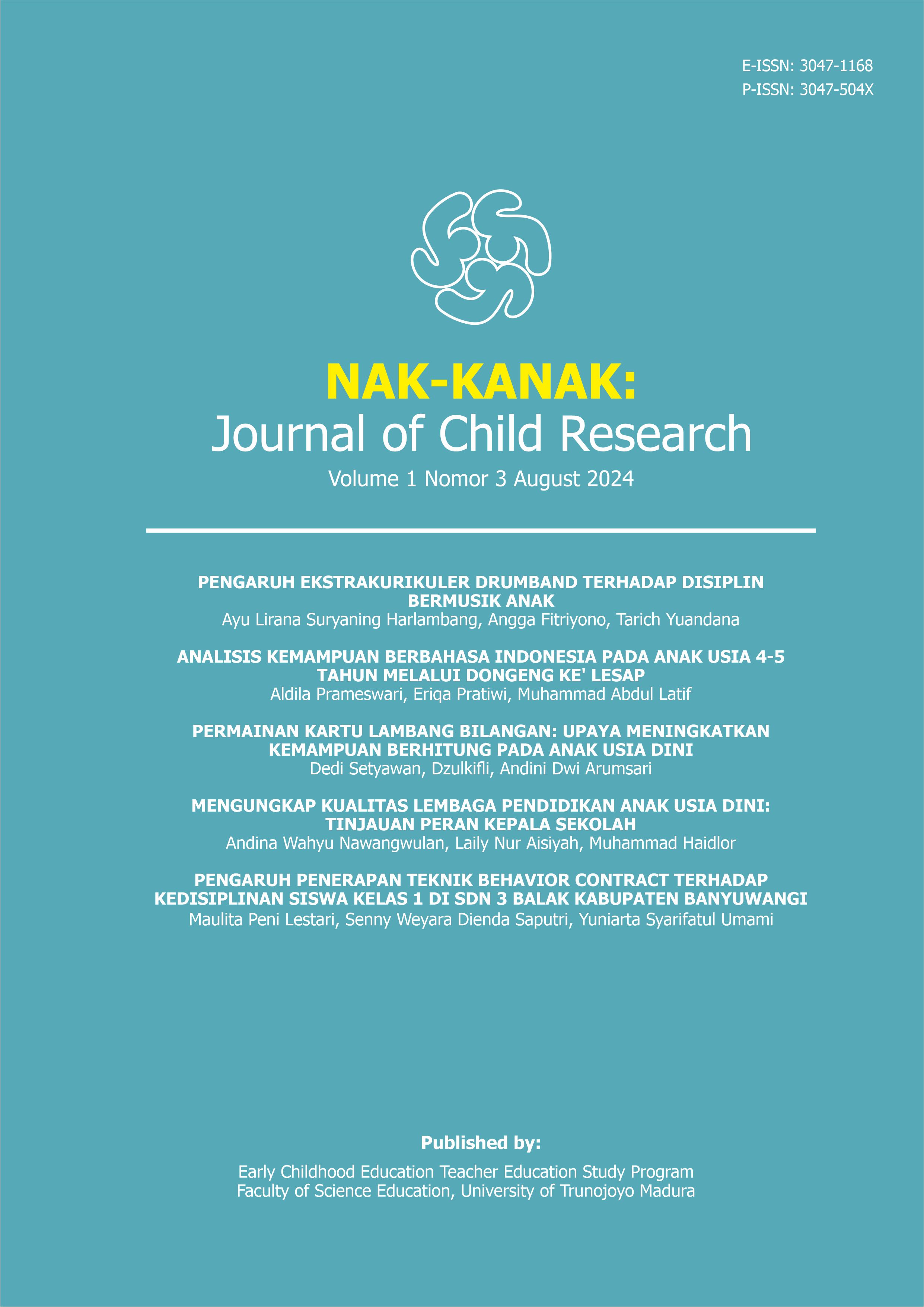
Pengaruh Ekstrakurikuler Drumband terhadap Disiplin Bermusik Anak
DOI:
https://doi.org/10.21107/njcr.v1i3.69Keywords:
Ekstrakurikuler drumband, Disiplin bermusik, Anak usia diniAbstract
The objective of this study is to examine the impact of extracurricular drumband activities on children's musical discipline. The research employs a quantitative approach utilizing a one-group pretest-posttest experimental design. Data were collected through pre-research interviews, documentation, and validated observations. The sample was drawn using a saturated sampling technique, encompassing the entire population, resulting in 31 respondents from TK Anna Husada Bangkalan. The findings indicate that the observation sheet's validity, comprising 8 items, reached a value of 87.5%, categorizing it as highly valid. Data analysis included normality tests and hypothesis testing using t-tests. The normality test results revealed that the pre-test value was 0.098 > 0.05 and the post-test value was 0.078 > 0.05, indicating a normal data distribution. The hypothesis test showed that the calculated t-value (t-count) was 41.375, exceeding the critical t-value (t-table) of 2.04227, leading to the acceptance of the alternative hypothesis (Ha) and rejection of the null hypothesis (H0). Consequently, it can be concluded that extracurricular drumband activities positively influence children's musical discipline. This research suggests that incorporating drumband activities in early childhood education can significantly enhance children's musical discipline. Schools and educators might consider integrating such extracurricular activities into their curriculum to foster better discipline and potentially improve overall academic and personal development outcomes for children. Future research could explore long-term effects and the impact of similar activities on other areas of children's growth.
Downloads
Published
How to Cite
Issue
Section
License
Copyright (c) 2024 Ayu Lirana Suryaning Harlambang, Angga Fitriyono, Tarich Yuandana

This work is licensed under a Creative Commons Attribution-NonCommercial 4.0 International License.
The authors publishing in this journal agree to the following terms:
1. Authors retain copyright and grant the journal the right of first publication with the work simultaneously licensed under a Creative Commons Attribution License that allows others to share the work with an acknowledgement of the work's authorship and initial publication in this journal.
2. Authors are able to enter into separate, additional contractual arrangements for the non-exclusive distribution of the journal's published version of the work (e.g., post it to an institutional repository or publish it in a book), with an acknowledgement of its initial publication in this journal.
3. Authors are permitted and encouraged to post their work online (e.g., in institutional repositories or on their website) prior to and during the submission process, as it can lead to productive exchanges, as well as earlier and greater citation of published work.